What we have learned building this, and what the evidence says about the firms we build it for.
Four pieces. Every figure is either published research, named and dated, or a measurement from our own systems. Where a source could not be read directly, the piece says so.
Recruitment · Adoption
Almost everyone is using AI. Almost nobody has embedded it
A report nobody opens is not adoption. It is a very well-informed file.
Are firms actually embedding AI, or just using it?
2,300recruitment professionals surveyed by Bullhorn
4×more likely to be using AI, among top-performing firms
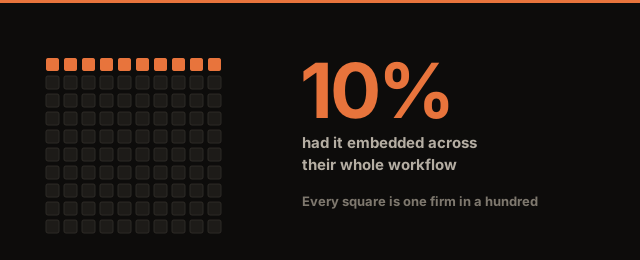
10%had it embedded across their whole workflow
Bullhorn asked nearly 2,300 recruitment professionals how they use AI. The top-performing firms were four times as likely to be using it. Only 10 per cent had it embedded across their whole workflow.
Both numbers are about the same firms, and the gap between them is the whole story. Almost everyone is using AI. Almost nobody has it anywhere that it changes what happens next.
Here is what that looks like from the inside, using our own company rather than a client's.
We ran a job every Monday that analysed our website traffic. It produced a genuinely good report. It wrote that report to a file. Nothing ever read the file back.
Meanwhile the dashboard we actually looked at said 49 sessions, because that number had been typed into the code on 28 July and never touched again. The real figure for the week to 10 August was 42, down 36 per cent. We had been reading a number that was three weeks old, and had no idea, because it looked current.
The AI was working perfectly. It was writing to a place nobody was reading from, and reporting into a place nobody was writing to.
That is the difference between using AI and embedding it, and it is not a model problem. It is a question of whether the output lands somewhere a person or a system acts on.
The question worth asking of your own setup is not how many tools you are running. It is which of their outputs changed a decision last week, and who can name one.
Sources. Nearly 2,300 recruitment professionals surveyed, top performers four times as likely to be using AI, and 10 per cent reporting AI embedded throughout their complete workflow: Bullhorn GRID 2026 Industry Trends Report, sixteenth annual edition. The survey is global rather than UK only.
The 49 against 42 sessions figure, the value hardcoded on 28 July, and the weekly job writing to a file nothing read back are this company's own record.
Accountancy · Capability
Two-thirds are paying to upskill. One in six can tell whether it worked
That is not an adoption gap. It is a measurement gap, and it has a different fix.
Does paying to upskill people on AI work?
86%have AI inside their technology strategy
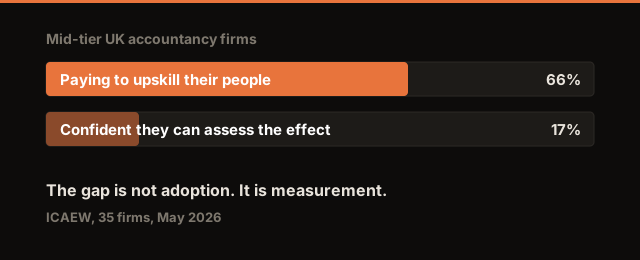
66%are paying to upskill their people on it
17%are confident they can assess what it does to their workforce
Eighty six per cent of mid-tier UK accountancy firms have AI inside their technology strategy. Sixty six per cent are paying to upskill their people on it.
Seventeen per cent feel confident they can assess what it will do to their workforce.
Those figures come from ICAEW's Evolution of mid-tier accountancy firms, published in May 2026, from managing partners and chief executives at 35 UK firms of between 11 and 249 principals. A small sample, and worth naming as one. It is also the rare piece of sector research that describes a real buyer rather than a global average.
The pairing that matters is 66 against 17. Two-thirds are already spending money on capability. One in six can tell whether the spending has produced any.
Here is why that is so common. Capability leaves almost no trace. What an organisation can easily count is attendance, licences issued, and how confident people say they feel. None of those is evidence. Somebody can sit through the course, hold the licence, report high confidence, and still not be able to finish a piece of real work to the standard the firm signs its name to.
Capability only becomes measurable when it produces something. A piece of the person's own work, done with the tool, judged by somebody other than the person who did it.
So the question worth asking before the next training invoice is approved is not how many people will attend. It is what each of them will have produced by the end, and who is going to look at it.
That is how Claude Readiness is built. You finish with something you made from your own work, and a credential graded on the server with a page anyone can verify.
Sources. The 86, 66 and 17 per cent figures: ICAEW, Evolution of mid-tier accountancy firms, third annual edition, 35 UK member firms of 11 to 249 principals, surveyed February and March 2026, published May 2026.
The 86 per cent figure also appears in the 2025 edition of the same research meaning something else entirely, so the year and the question are named here deliberately.
Agents · Automation
Our scheduled jobs were not failing. They were waiting
Automated work rarely fails loudly. It fails by waiting, and waiting produces the same silence as success until somebody counts.
Why do unattended AI jobs stall without failing?
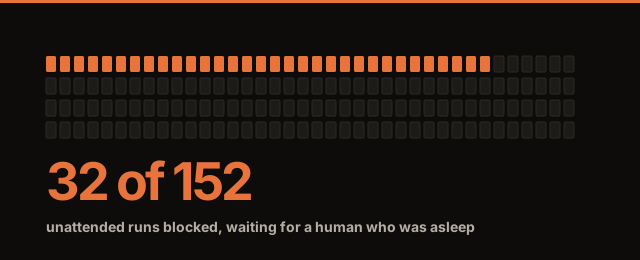
32 of 152unattended runs blocked waiting for a human, over nine days
21 hoursthe longest single block, on a job that runs unattended by definition
3separate records held the answer between them, none read against the others
For weeks the pattern read as unreliability. A job fires overnight and in the morning there is no output. No error, no crash report, nothing in anything anyone reads. The scheduler says the run started on time, which is true and tells you nothing.
What was actually happening is duller and worse. The job runs, asks permission for a tool a few seconds in, finds nobody at the keyboard, and blocks. It stays blocked until the laptop sleeps, at which point the process is killed.
We went back through nine days. Of 152 unattended runs, 32 blocked waiting for a human. Seven were killed while still blocked. Five produced no output at all.
The clearest single case: a job started at 19:21 on 16 August and was answered at 16:20 the following afternoon. Twenty-one hours, on a job that runs unattended by definition, waiting for one click.
Two things here are worth more than the numbers.
The first is that the fix had already shipped and did not arrive. On 14 August auto mode became the default for Claude Code, which is precisely the answer to this problem. It did not reach these jobs, because where a different default has already been set the change arrives as a prompt asking whether to switch. The fix for nobody being there to answer a question was delivered as a question.
The second is why this ran for weeks unnoticed. Three separate records existed. The scheduler knows a job fired. The session transcript knows what it did. The application log knows why it stopped. Only the third holds the answer, and none of the three had ever been read against the others. We had to build the thing that compares them before we could see any of it.
So the question worth asking of anything you have automated is not whether it ran. It is what proportion of runs finished, and where you would go to find out. If you cannot answer the second, you do not know the first either.
Sources. The nine-day counts and the twenty-one hour block are this company's own record, reconciled across the Windows scheduler record, the session transcripts and the desktop application log.
Auto mode becoming the default on 14 August 2026, and the behaviour that a machine with a different default set receives the change as a one-time prompt, are both from Anthropic's published permission-modes documentation. The documented behaviour is reasonable and the failure was ours for leaving a default in place.
Method · Judgement
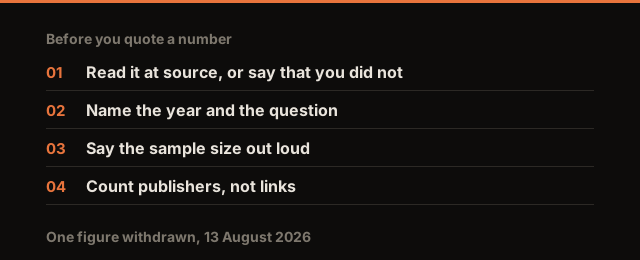
Four checks before you quote a number
Producing a fluent paragraph with a confident number in it costs almost nothing today. Deciding whether the number is true costs exactly what it always did.
How do you check a number before you quote it?
35firms in the sample, said out loud rather than left to be discovered
86%the same figure in two editions, meaning two different things
2publishers needed before a number is corroborated rather than repeated
We withdrew a statistic from our own research note on 13 August. It had not gone anywhere, which is the only reason this is a useful story rather than an embarrassing one.
The figure was a percentage about accountancy firms and headcount. It read well and it fitted the argument, which is the warning sign rather than the reassurance. When somebody went to read it at source, it was on none of the pages it should have been on. Not contradicted. Absent. So it is now marked wrong rather than unconfirmed, and those are different states.
Four checks came out of that morning, and they are worth having whether or not you ever quote a survey.
Read it at source, or say that you did not
The pages we needed render through JavaScript and return only navigation to an automated fetch, and one trade article returned a 403. So no page body was read directly and the note says exactly that. The figures came from indexed text across two independent retrievals and were corroborated against a second publisher. Three consistent passes, two publishers, and that is enough to quote with attribution.
Name the year and the question
One headline figure in that research is 86 per cent. The same 86 per cent appears in the previous edition of the same research meaning something else entirely, the share of firms ranking private equity among their top three macro trends. Same number, same publisher, nothing to do with AI. Anyone quoting it without the year is calling a coin flip and sounding certain.
Say the sample size out loud
Ours was 35 firms. That is a real finding about a real population and it is also 35 firms. A reader who learns that from somebody else stops believing the rest of what you wrote.
Count publishers, not links
Two outlets reporting the same number independently is corroboration. Six outlets citing the same press release is one source wearing six coats.
None of this is difficult. It is slower than not doing it, which is why it mostly does not happen.
It matters more now than it did, and not because models lie.
The failure has stopped announcing itself: it arrives well written, correctly formatted and plausible, and the skill that catches it is the same one whether the draft came from a model or from a colleague.
Sources. Every claim here is this company's own record from 13 August 2026: the withdrawn figure, the JavaScript-rendered pages and the 403, the two independent retrievals plus second publisher, the 35 firm sample, and the 86 per cent appearing in the earlier edition meaning something else.
The research is ICAEW, Evolution of mid-tier accountancy firms, published May 2026. It is not named in the body above deliberately: this is about method, and naming the publisher would read as a complaint about them when the error was entirely ours.
The Intelligence Platform exists to have done this work before you need it, with the uncertainty stated where it exists. Claude Readiness and the platform start free at signalcroft.ai. Fourteen days, no card.